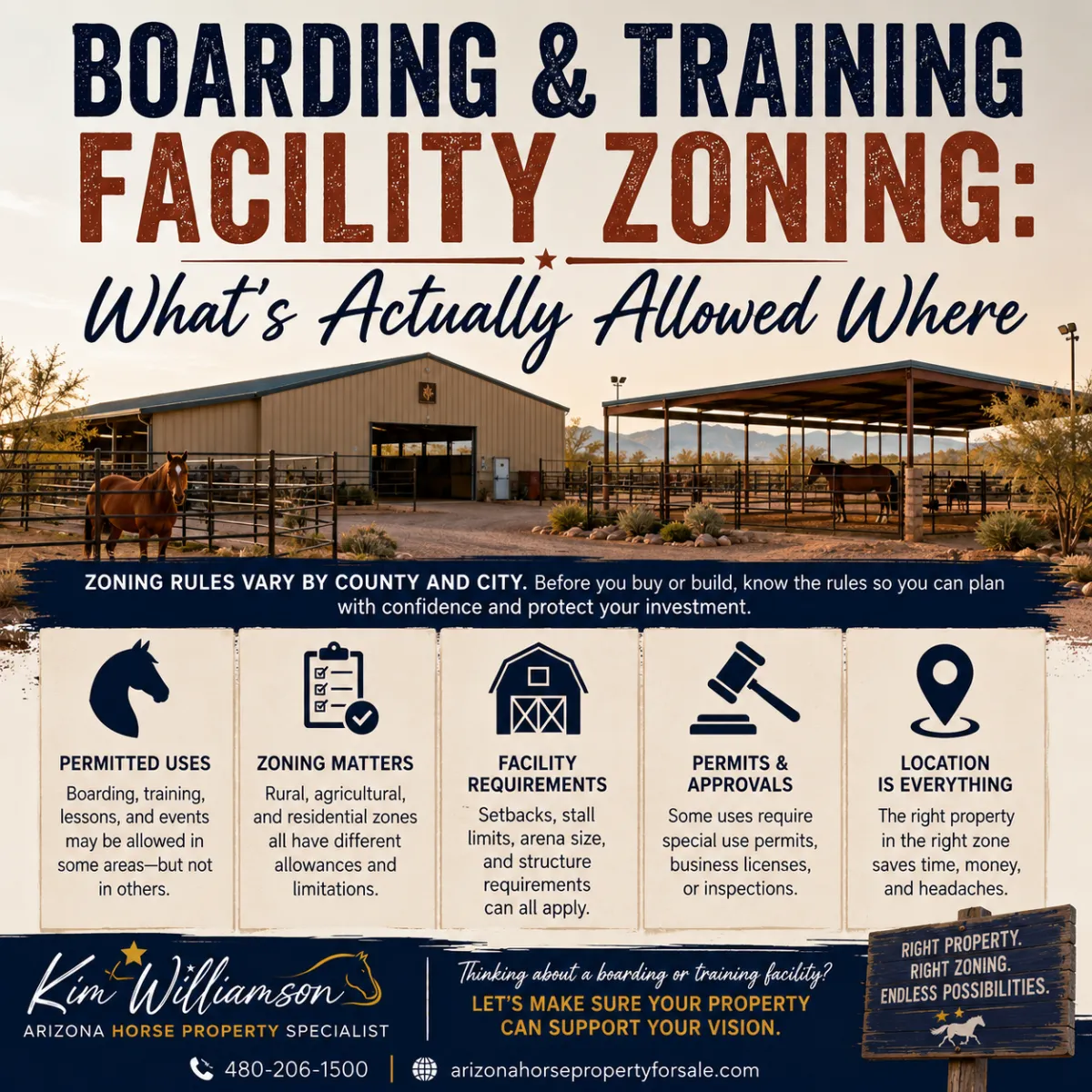
Boarding & Training Facility Zoning: What's Actually Allowed Where
Boarding & Training Facility Zoning: What's Actually Allowed Where
I get this question constantly from buyers who want to run any kind of boarding or training operation on their own property: "Can I actually do this here?" The honest answer depends entirely on acreage, zoning district, and how many horses are involved — and it's not something to guess at.
The Acreage Threshold That Changes Everything
In Maricopa County, commercial breeding, raising, boarding, or training of equine requires at least 5 contiguous commercial acres. That number is the dividing line between what's treated as a personal accessory use and what's treated as a commercial operation requiring separate approval. Land used for grazing or general agricultural purposes on 5 or more contiguous commercial acres is exempt from certain zoning regulations altogether — but that exemption applies to agricultural use, not automatically to a boarding business.
What's Allowed as an Accessory Use — and What Isn't
On a standard Rural-zoned residential property, keeping and riding your own horses is a permitted accessory use. But several related activities cross the line into needing separate approval: boarding six or more horses is not permitted as an accessory use in Rural zoning, riding lessons aren't permitted except in conjunction with boarding, and arenas hosting events with 25 or more people fall outside accessory use as well. If your plan involves boarding other people's horses at any real scale, giving lessons, or hosting events, you're very likely in Special Use Permit territory, not simple accessory use.
Special Use Permits
A Special Use Permit (SUP) is what covers public riding and boarding stables, equine boarding and training, riding lessons, horse rentals, and staging for off-site trail rides. Recreational open-air facilities — including rodeos, team roping, barrel racing, penning, and mounted cowboy shooting — can also be permitted as a Special Use in appropriate zoning districts. An SUP is a real approval process, not a formality, and it's worth budgeting time and, often, professional help into any purchase plan that depends on one.
Setbacks Vary More Than People Expect
Setback requirements for barns, stables, and livestock containment areas differ significantly by municipality, and this is a detail I see overlooked constantly. In Surprise, livestock structures and containment areas used for stabling, showing, or training must sit at least 100 feet from any property line. In Apache Junction, barns and stables housing equine need a minimum 50-foot setback on the side, rear, and front. These are meaningfully different numbers, and they directly affect where you can actually build on a given lot — verify your specific municipality's setback requirement before you finalize a site plan, not after.
A Note on Pinal County
Everything above reflects Maricopa County and specific incorporated cities within it. I wasn't able to confirm equivalent Pinal County boarding and zoning specifics in researching this piece — if your property is in Pinal County (including much of San Tan Valley), confirm directly with Pinal County Development Services before assuming Maricopa County's rules apply the same way.
Questions to Ask Before You Buy for a Boarding or Training Business
1. Is this parcel at least 5 contiguous commercial acres, and is that acreage zoned to allow commercial equine use?
2. How many horses do you actually plan to board, and does that number stay under the accessory-use threshold or require an SUP?
3. Do your plans include lessons, events, or public access — any of which can trigger permit requirements on their own?
4. What's the exact setback requirement for barns and containment areas in this specific municipality or county?
5. Has a Special Use Permit ever been applied for or granted on this property, or would you be starting that process from scratch?
The Bottom Line
Running any kind of boarding or training operation isn't just a matter of having the acreage — the zoning district, the number of horses, whether lessons or events are involved, and the specific municipality's setback rules all determine what's actually allowed. Verify all of it with the county or city directly before you buy with a business plan attached to the purchase.
Thinking about a property with boarding or training income in mind? Call or text Kim Williamson at 480-206-1500 or visit www.ArizonaHorsePropertyForSale.com.
Kim Williamson, REALTOR® | 8x WPRA World Champion | 24 years East Valley experience | Real Broker | 480-206-1500 | arizonahorsepropertyforsale.com
Zoning and setback requirements are general information current as of this writing and vary by municipality. Always verify current requirements directly with the applicable county or city before purchase.