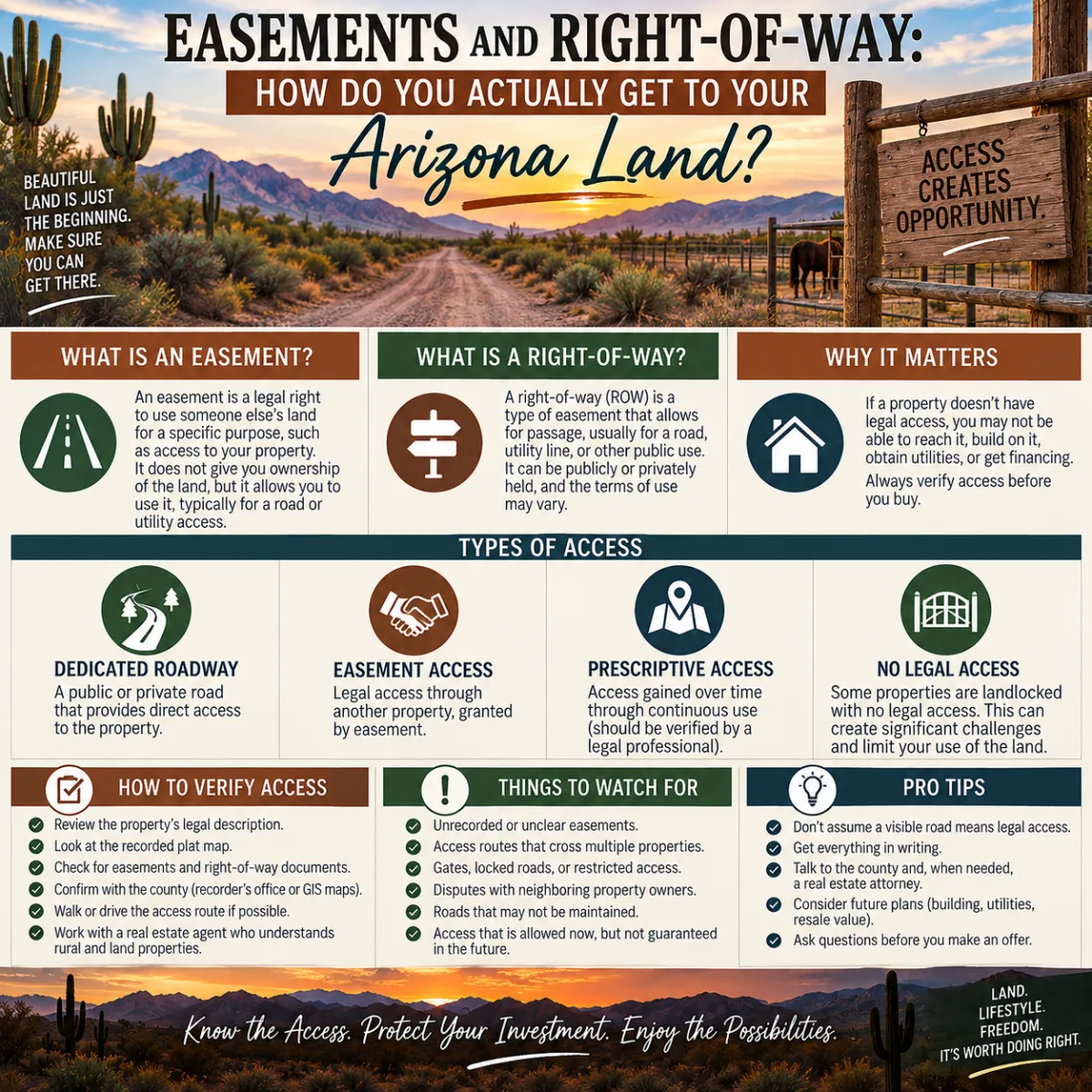
Easements and Right-of-Way: How Do You Actually Get to Your Arizona Land?
Picture Diane. She just found five acres outside Queen Creek with room for her two horses and a sunset view she could sit with every evening. The dirt road to the gate curves through a neighbor's parcel, the way it has for as long as anyone can remember. Nobody thinks twice about it.
Here's the question nobody asked: does that property actually have legal access, or does the driveway just happen to cross someone else's land?
On rural acreage, those are two very different things. And it's exactly the kind of hidden issue you want answered before you buy, not after.
Why Access Is a Real Question on Rural Land
A driveway you can see is not the same thing as a right to use it. On acreage, a driveway can wind across neighboring land in ways you'd never spot from a listing photo or a satellite view.
A property can look perfectly accessible and still have no recorded, legal right of access. You don't want to discover that when you go to sell, when a new neighbor puts up a gate, or when a lender asks for proof.
What an Easement Actually Is
An easement is a legal right to use someone else's land for a specific purpose. For rural property, the one that matters most is an access easement: the right to cross a neighbor's land to reach yours. Easements can also cover things like utility lines, irrigation ditches, and shared wells, so you want to know about all of them before you buy.
1. Recorded (Express) Easement
This is the cleanest version: a written agreement, recorded with the county, that spells out where the access runs and what it can be used for.
You still want to read it, because the terms matter. Does it allow horse trailers and hay deliveries, or was it written with a passenger car in mind? Does it say who maintains the road?
2. Prescriptive Easement
This one comes from long-term use instead of a document, and it's where "it's always been that way" can get complicated.
Arizona's statute, A.R.S. § 12-526, sets a ten-year period for actions to recover land from someone who has "peaceable and adverse possession" of it and is "cultivating, using and enjoying such property." The Arizona Court of Appeals has described how the Arizona Supreme Court, in a 1949 case, treated repeated flooding of a landowner's property as a prescriptive easement and applied that ten-year period.
But use alone isn't enough. Arizona courts have said that mere use of another's property is insufficient to "create ownership or prescriptive use, without some additional act or circumstances indicating that the use is not merely permissive but hostile to the owner's rights." In other words, a neighbor who let you use the road as a favor may not have given you any legal right at all.
And a prescriptive easement isn't written down anywhere. If it's ever challenged, it may have to be proven in court, and courts look at the circumstances of each case. Finding out can be expensive.
3. Landlocked Land
If a parcel has no way to reach a public road except across neighboring land, don't assume access exists just because it's needed. That is a question for a real estate attorney before you buy, not after.
Why "It's Always Been That Way" Isn't Good Enough
A seller who says the driveway has crossed the neighbor's corner for 30 years usually means it sincerely.
But access that rests on habit instead of a recorded document can be challenged, especially when either property changes hands. A new neighbor may not honor an old handshake. A lender or title company may flag it. A future buyer may walk away. A written, recorded easement spells out exactly what's allowed.
A Survey Isn't Optional on Acreage
A current survey shows where your boundaries are, where recorded easements run, and whether the driveway you use today actually sits inside them. Those aren't always the same line.
Pair the survey with a careful read of the title report. Recorded easements show up there, and your title company can help you understand them. For the full due diligence picture, my Arizona horse property inspection checklist walks through what to check, and my guide to buying land for horse property in Arizona covers raw land specifically.
Questions to Ask Before You Buy
Is legal access to this property documented in a recorded easement, and have you read its terms?
Does the easement allow the traffic you'll actually have: horse trailers, hay trucks, and vet and farrier visits?
Does a current survey confirm the driveway sits inside the recorded easement?
If access depends on long-time use rather than a recorded document, has a real estate attorney reviewed it?
Are there other easements on the property, such as utility lines, irrigation ditches, or a shared well, that affect how you can use the land?
Who is responsible for maintaining a shared access road, and is that in writing?
Shared wells and septic systems raise their own questions, so if the property has either, read Septic Systems on East Valley Acreage before you get too far along.
Build It Into Your Timeline
Access questions take time to answer, especially if an easement needs to be recorded or cleaned up before closing. Give yourself room in your inspection period to order a survey and have your title company, and an attorney if needed, review what they find. My article on how long it takes to close on horse property in Arizona explains how to plan for that.
Frequently Asked Questions
What is an easement in Arizona? An easement is a legal right to use someone else's land for a specific purpose, such as crossing it to reach your property or running utility lines.
Can long-term use of a driveway create a legal right in Arizona? It can, but not automatically. A.R.S. § 12-526 sets a ten-year period tied to adverse possession, and Arizona courts have said that mere use isn't enough without circumstances showing the use was hostile rather than permissive. Have a real estate attorney review any access that isn't recorded.
How do I find out if a property has legal access? Review the title report for recorded easements, order a current survey, and have a real estate attorney look at anything that isn't clearly recorded.
What if rural land doesn't have recorded access? Talk to a real estate attorney before you buy. A recorded agreement with the neighbor is the cleanest fix, and it's far easier to sort out before closing than after.
The Bottom Line
Legal access to rural land isn't automatic just because a driveway exists. Know what kind of easement applies, get a current survey, read the title report, and don't let "it's always been that way" stand in for real due diligence.
If Diane checks all of that before closing, she buys her five acres knowing she can always get her horses home. No surprises, no regrets.
Looking at land or horse property anywhere in the Metro Plex of Arizona and want the access question answered before you commit? Call or text Kim Williamson at 480-206-1500 or visit ArizonaHorsePropertyForSale.com.
Kim Williamson, REALTOR® | 8x WPRA World Champion | 1,000+ transactions | 24 years selling real estate | 36 years living in Arizona | Real Brokerage | 480-206-1500
This article is general information, not legal advice. Easement questions depend on the specific facts of each property. Always consult a real estate attorney, your title company, and a licensed surveyor about your situation.
Sources: A.R.S. § 12-526, azleg.gov/ars/12/00526.htm (checked 2026-09-15); Flood Control District of Maricopa County v. Gaines, No. 1 CA-SA 01-0186 (Ariz. Ct. App. April 2, 2002), describing Maricopa County Municipal Water Conservation District No. 1 v. Warford, 69 Ariz. 1 (1949) (checked 2026-09-15); Herzog v. Boykin, 148 Ariz. 131, 133 (App. 1985), as quoted by the Arizona Court of Appeals in No. 1 CA-CV 06-0803 (2007) (checked 2026-09-15).