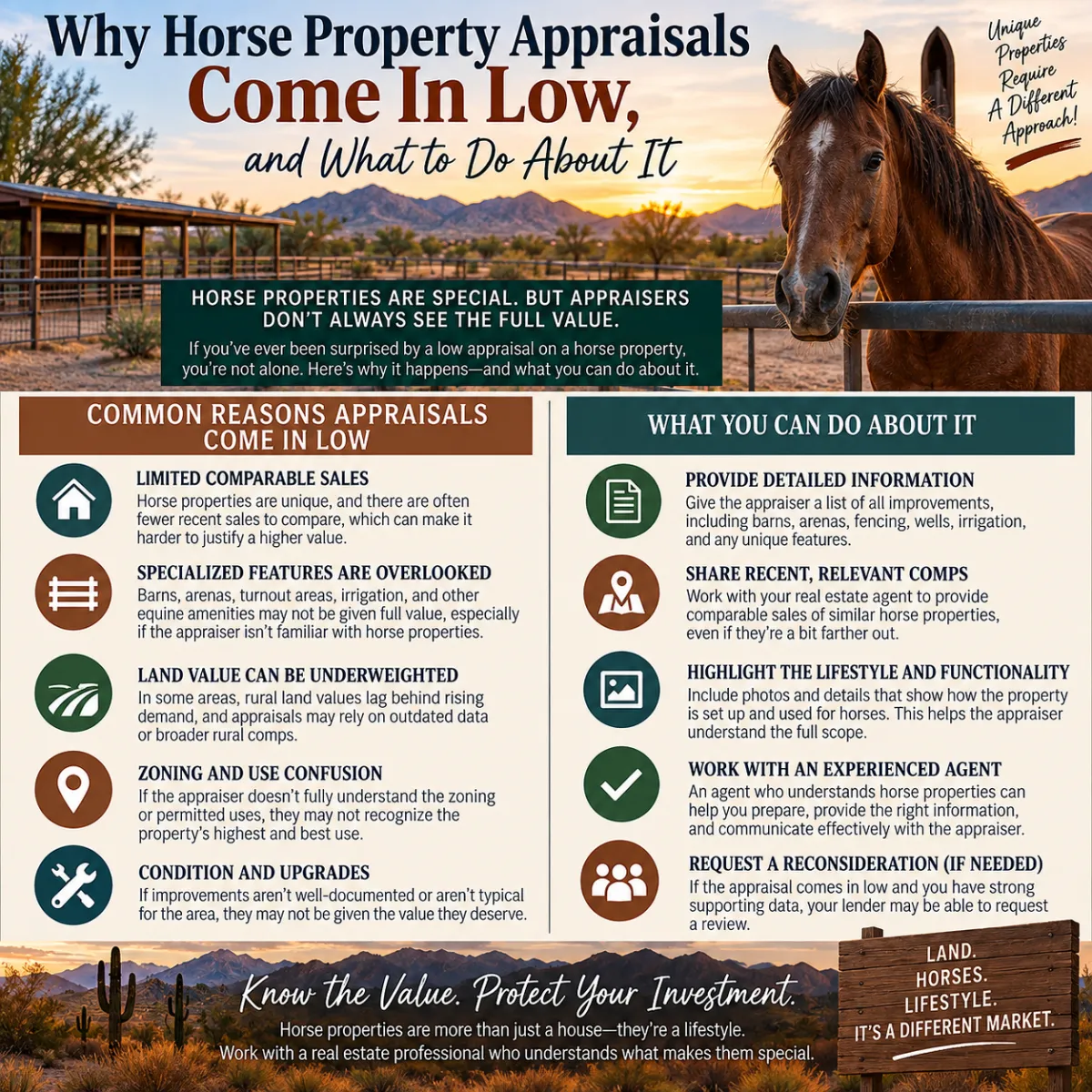
Why Horse Property Appraisals Come In Low, and What to Do About It
Why Do Horse Property Appraisals Come In Low?
Most of the time, it comes down to comparable sales. An appraiser estimates value largely by comparing a property to similar properties that sold recently. On horse property, truly similar sales can be hard to find.
Truly Comparable Sales Are Scarce
Fannie Mae's Selling Guide says it plainly: "Rural properties often have large lot sizes, and rural locations can be relatively undeveloped. Therefore, there may be a shortage (or absence) of recent truly comparable sales in the immediate vicinity of a subject property."
The guide says comparable sales that closed within the last 12 months should be used, but that the best and most appropriate comparables may not always be the most recent. And when the best indicators of value are a considerable distance away, those sales can be used if they produce credible results, as long as the appraisal explains why they were selected. Every step further from a true match gives the value more room to drift.
Barns, Arenas, and Outbuildings Get Special Scrutiny
You might have spent a small fortune on a barn and arena. Fannie Mae's Selling Guide says a lender must give properties with outbuildings special consideration in the appraisal review "to ensure that the property is residential in nature." For properties with minimal outbuildings, the appraiser must demonstrate, through comparable sales with similar amenities, that the improvements are typical of other residential properties in the area. If there are few recent sales with comparable facilities, that's hard to show.
Features the Appraiser Can't Easily See
Flood irrigation rights, well production, fencing quality, arena footing, and a layout that truly works for horses all matter to horse buyers. But if those details aren't documented and handed to the appraiser, they can be underweighted or missed. I break down irrigation in What Is Flood Irrigation Worth on Arizona Horse Property?
The Price Got Ahead of the Data
Sometimes a competitive situation pushes a price above what recent sales support. The buyer and seller agreed, but the appraiser has to follow the data. That's one reason pricing horse property correctly from the start matters, which I cover in How to Price Horse Property in Arizona.
How Does the Appraisal Contingency Protect Buyers in Arizona?
The Arizona REALTORS® residential resale purchase contract includes an appraisal contingency. As Arizona REALTORS® quotes it: "If the Premises fail to appraise for the purchase price in any appraisal required by lender, Buyer has five (5) days after notice of the appraised value to cancel this Contract and receive a refund of the Earnest Money or the appraisal contingency shall be waived, unless otherwise prohibited by federal law."
That five-day window is short. When a low appraisal comes in, you and your agent need to move fast and decide on your next step.
What Can You Do About a Low Appraisal?
1. Ask About a Reconsideration of Value
A reconsideration of value, often called an ROV, is a request asking the appraiser to take another look, for example when better comparable sales were overlooked or there's information the appraiser didn't have. On May 1, 2024, Fannie Mae, in collaboration with Freddie Mac and HUD, published requirements for a borrower-initiated ROV, and under Fannie Mae's requirements the borrower may request a maximum of one ROV for each appraisal report.
FHA is different. In Mortgagee Letter 2025-08, dated March 19, 2025, FHA rescinded the borrower-initiated ROV updates it had issued in 2024 and restored its previous policy. So on an FHA loan, ask your lender exactly what process applies.
The strongest request includes specific, recent sales of similar horse properties, plus documentation of features like irrigation rights, well reports, and improvements.
2. Renegotiate the Price
The seller may agree to lower the price to the appraised value, or the buyer and seller may meet somewhere in the middle.
3. Cover the Gap
If the buyer has the cash and still believes the property is worth the contract price, they can pay the difference between the appraised value and the price. Talk to your lender about how that affects your down payment and loan amount before you decide.
4. Cancel Within the Contingency Window
If none of those options work, the appraisal contingency lets a buyer cancel within five days after notice of the appraised value and receive a refund of the earnest money. It's not the outcome anyone wants, but it's there to protect you from overpaying.
What Can Sellers Do Before the Appraisal?
Sellers can help before the appraiser ever arrives. Have your agent prepare a packet with recent comparable horse property sales, a list of improvements with dates and costs, irrigation documentation, well reports, and anything else that makes your property stand out. Appraisers work from data, so give them good data. My guide to what adds and hurts horse property value in Arizona is a helpful place to start.
Frequently Asked Questions
Why do horse property appraisals come in low in Arizona? Often because truly comparable sales are scarce in rural areas, which Fannie Mae's Selling Guide acknowledges, and because barns, arenas, and features like irrigation rights have to be supported by comparable sales and documentation.
How long does an Arizona buyer have to cancel after a low appraisal? Under the Arizona REALTORS® residential resale purchase contract, the buyer has five days after notice of the appraised value to cancel and receive a refund of the earnest money, or the appraisal contingency is waived, unless otherwise prohibited by federal law.
Can you challenge a low appraisal? You can ask your lender about a reconsideration of value. Fannie Mae allows a borrower one ROV per appraisal report, while FHA restored its previous ROV policy in March 2025, so ask your lender which process applies to your loan.
What should sellers give the appraiser? Recent comparable horse property sales, a list of improvements with dates and costs, irrigation documentation, and well reports.
The Bottom Line
A low appraisal on horse property is a speed bump, not necessarily a dead end. Know why it happened, act inside your five-day window, and bring real data. If Diane's agent submits strong comparable sales and documents her irrigation rights, she has a real shot at saving the deal, or at least renegotiating it with confidence.
Financing horse property has its own quirks, too, so read horse property financing in Arizona before you apply.
Buying or selling horse property anywhere in the Metro Plex of Arizona and want someone who's ready for the appraisal before it happens? Call or text Kim Williamson at 480-206-1500 or visit ArizonaHorsePropertyForSale.com.
Kim Williamson, REALTOR® | 8x WPRA World Champion | 1,000+ transactions | 24 years selling real estate | 36 years living in Arizona | Real Brokerage | 480-206-1500
This article is general information, not legal or lending advice. Contract terms, loan programs, and appraisal rules change. Always review your own contract and talk with your lender and a real estate professional.