Rural Internet and Cell Service on Arizona Horse Property: What to Check Before You Buy
Picture a couple, Michael and Jennifer. They're relocating from California with two horses, they both work from home three days a week, and they just found the one. Five acres outside San Tan Valley, a mare motel, a round pen, and mountain views off the back patio. They're ready to write an offer tonight.
Then Jennifer asks the question that should have come first: "Wait... can we actually work from here?"
This happens more often than you'd think. Buyers fall in love with the barn, the arena, and the acreage, and internet is an afterthought until the day they move in and their first video call freezes. On horse property, that question deserves the same attention as the well, the septic, and the fencing. Here's how I walk my clients through it.
Why You Can't Assume Internet Out Here
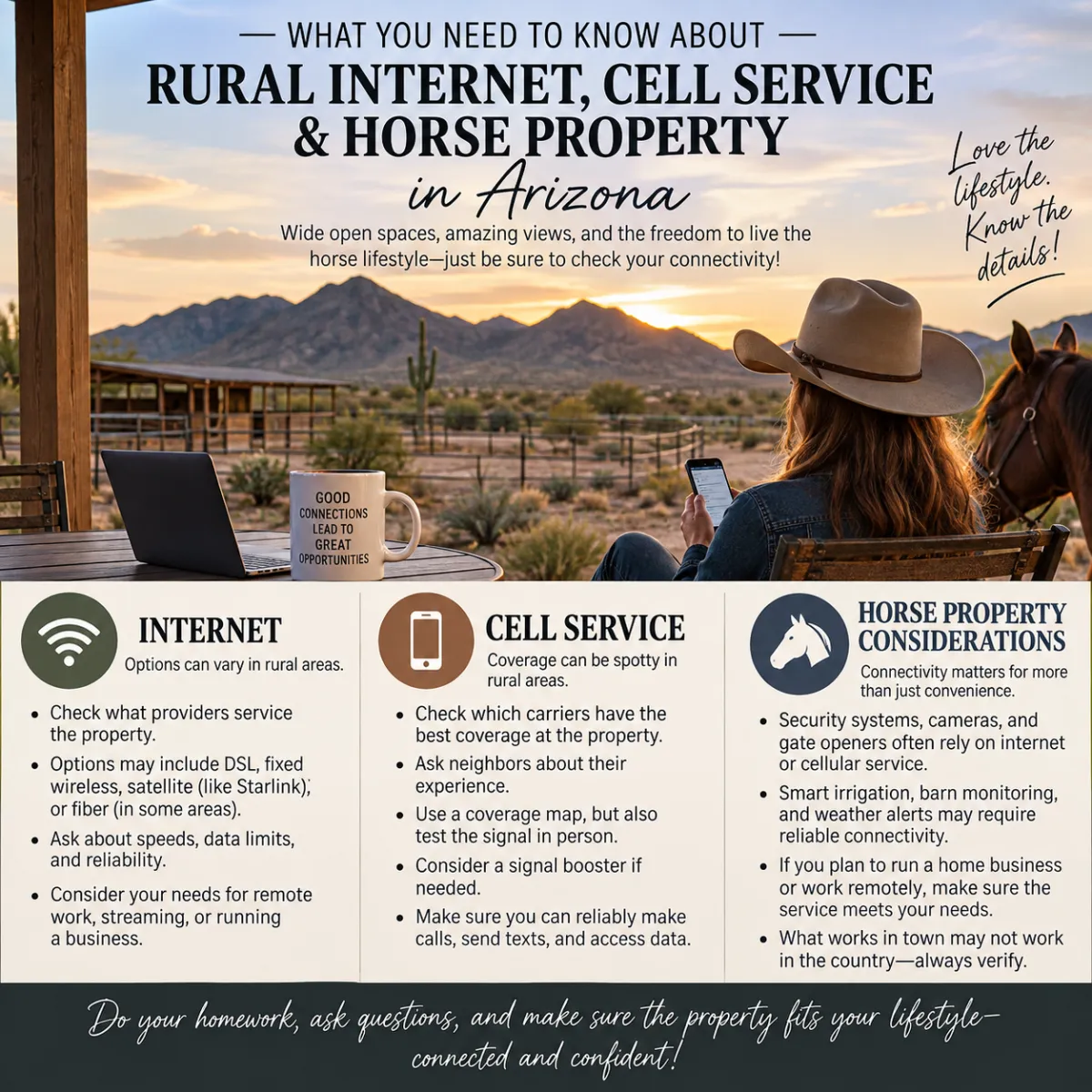
In town, internet is a given. Cable and fiber run down every street, and you just pick a plan. Once you head out toward the edges of Queen Creek, San Tan Valley, Apache Junction, and the rural parts of Pinal County, that changes fast. Two properties a mile apart can have completely different options. One might have fiber at the road. The other might have nothing wired at all.
A listing that says "high-speed internet available" doesn't tell you much either. It might mean fiber to the house. It might mean someone once got a satellite dish to work. You want to know what's available at that exact address, not in the general area.
Your Real Options on Rural Acreage
1. Starlink Satellite Internet
Starlink has changed the conversation on rural property. It works almost anywhere with a clear view of the sky, and for a lot of acreage it's now a reliable everyday option, not the slow, laggy satellite service people remember from years ago.
As of mid-2026, Starlink's residential plans run about $55, $85, or $130 a month depending on the speed tier, plus the cost of the equipment. Real-world download speeds on the entry plan typically land between 60 and 130 Mbps in rural areas, and the higher tiers can run faster. For most families streaming, working, and doing video calls, that's plenty.
The catch is the sky view. Tall trees, a big barn roofline, or a hillside in the wrong spot can block the signal. Walk the property and look for a clear spot to mount the dish before you assume it will work.
2. 5G Home Internet (Fixed Wireless)
If the property already has decent cell signal, 5G home internet from T-Mobile or Verizon is often the better value. In September 2026, both carriers list plans running roughly $50 to $75 a month with AutoPay, with discounts if you bundle a phone line. Latency is usually lower than satellite, which matters for video calls.
The limitation is simple: it only works if a tower is close enough. Both carriers let you check eligibility by exact address on their websites, and it takes about two minutes. Do it before you write the offer.
3. Fiber or Cable
Some rural properties near newer subdivisions or main roads do have fiber or cable available. If it's there, it's usually the fastest and most stable option. Just don't assume the line runs all the way to the house. Sometimes it stops at the road, and bringing it in across a long driveway can cost real money.
Cell Service Is a Separate Question
Internet and cell service are two different things, and both matter on horse property. If you're out at the barn at 9 p.m. with a colicky horse, you need to be able to call your vet. I wrote about lining up your vet and farrier before you buy in Finding a Vet and Farrier in Rural Arizona, and a phone that works at the barn is part of that plan.
Carrier coverage maps are a starting point, not a guarantee. The only real test is standing on the property with your own phone. Check your signal at the house, at the barn, and at the far end of the pasture.
Connectivity Affects Resale, Too
Even if you personally don't need fast internet, your future buyer probably will. Remote work is a big part of how a lot of relocation buyers live now, and one of their first questions about rural property is whether they can work from it. A property with solid, documented internet options is simply easier to sell. It's not the flashiest feature on the listing, but it removes a reason for someone to say no. For the bigger picture on what moves value up or down, read what adds and hurts horse property value in Arizona.
Rural Broadband Is Getting Better
There's good news if a property has weak options today. Arizona's plan for the federal Broadband Equity, Access, and Deployment program (BEAD) was approved in late 2025, and providers are working on expanding rural coverage across the state. A property with limited choices now may have better ones in the next few years. I wouldn't buy on that promise alone, but it's worth knowing.
Questions to Ask Before You Write an Offer
What internet service does the current owner actually use, and what do they pay?
Is there a clear view of the sky for a Starlink dish, away from trees and roof obstructions?
Does T-Mobile or Verizon 5G home internet show as available at this exact address?
Is fiber or cable available at the road, and does it run all the way to the house?
How many bars do you get on your own phone at the house, the barn, and the back pasture?
If you work from home, have you tested upload speed, not just download?
Internet is one item on a much longer list. My 30-point Arizona horse property buyer checklist covers the rest. If you're thinking about going partly off-grid, read Off-Grid and Solar Options for Rural Arizona Acreage too.
Frequently Asked Questions
Does Starlink work on rural Arizona horse property? In most cases, yes. Starlink works almost anywhere with a clear view of the sky. The main thing to check is whether trees, a barn roofline, or a hillside block the spot where you'd mount the dish.
How much does rural internet cost in Arizona? As of September 2026, Starlink residential plans run about $55 to $130 a month plus equipment, and T-Mobile and Verizon 5G home internet plans run about $50 to $75 a month with AutoPay where service is available.
How can I check internet availability at a specific property? Enter the exact address on the Starlink, T-Mobile, and Verizon websites, ask the seller what service they use and what they pay, and test cell signal on your own phone at the house and the barn.
Should poor internet stop me from buying horse property? Not always, but it should be part of your decision. If you work from home, confirm at least one reliable option at that address before you make an offer.
The Bottom Line
If Michael and Jennifer check the address, confirm what service is actually available, and test their phones at the barn, they can write that offer the next morning with confidence instead of guessing. That's the difference between falling in love with a property and buying one that actually works for your life.
Before you commit to acreage, find out what internet and cell service really look like at that exact address. It takes an afternoon. Fixing it after closing takes a lot longer.
If you're relocating with horses, start with my complete guide to moving to Arizona with horses.
Thinking about horse property anywhere in the Metro Plex of Arizona and want someone who checks these details for you? Call or text Kim Williamson at 480-206-1500 or visit ArizonaHorsePropertyForSale.com.
Kim Williamson, REALTOR | 8x WPRA World Champion | 1,000+ transactions | 24 years selling real estate | 36 years living in Arizona | Real Brokerage | 480-206-1500
Internet plans, pricing, and availability change often. Always verify current options directly with each provider at the specific property address before you buy.
Sources (checked 2026-09-12): US Mobile, "Starlink Plans & Pricing in 2026" (usmobile.com/blog/starlink-cost); T-Mobile 5G Home Internet plans (t-mobile.com/home-internet/plans) and BroadbandNow T-Mobile deals, September 2026; Verizon 5G Home Internet plans (verizon.com/home/internet/5g); KJZZ, "Arizona gets approved for $447M to help bring broadband internet to rural, tribal areas," December 4, 2025.